
Sports and the Environment are closely connected—sports depend on natural resources, and sporting activities can significantly impact the planet.
First, let’s establish the major features of that connection:
Sports can place pressure on the environment in several ways:
Environmental changes directly influence sports performance and safety:
Now let’s think out of the box:
Both have become increasingly important in our societies, whatever country we live in, wherever we are. Climate change is global and affects us all. The same is true for sport: more and more people are taking part in physical activity, as they are more and more convinced that this is good for their health and well-being. So, what used to be areas of minor interest for governments and politicians (back in the 80s) have now become far more central, far more important issues and led path to specific policies, acts, and law.
This shift in politics has not reached its optimum level yet, as climate change is becoming a more pressing issue, and requires us all to do more to counteract its devastating effects. Similarly, people’s interest in sports is still developing: physical activity is good for physical health, but not only: it is even probably essential for mental health (another emerging and pressing issue), as well as social interaction, reinforcing the bond between people and generations, when technology through social media, smartphones etc make it less direct, less physical, hence more distant.
To sum up, both the environment and sports will be more and more central, important and intertwined issues and areas of interests in the decades to come, for different reasons that have common ground though.
A. Environment
Table 1. Climate & Physical Risk Indicators
Global Temperature Increase (vs. pre-industrial)
| Year | Median Projection | Range |
|---|---|---|
| 2025 | +1.3 °C | 1.2–1.4 |
| 2035 | +1.6 °C | 1.4–1.8 |
| 2050 | +2.0 °C | 1.7–2.4 |
Interpretation:
Crossing 1.5 °C (expected ~2030–2035) sharply increases economic and political pressure.
Table 2. Extreme Weather Frequency
| Indicator | 2020s | 2030s | 2050 |
|---|---|---|---|
| Heatwaves (per year) | Baseline ×1.5 | ×2–3 | ×4–6 |
| Flood events | +30% | +60% | +100% |
| Drought-affected land | 15% | 20–25% | 30–35% |
-> Drives insurance exits, food price volatility, migration.
Table 3. Economic Impact
Global GDP at Risk
| Year | % Global GDP Lost Annually |
|---|---|
| 2025 | 1–2% |
| 2035 | 3–5% |
| 2050 | 5–10% (up to 15% in worst-case scenarios) |
This compares to:
Table 4. Climate Adaptation & Mitigation Spending
| Category | 2025 | 2035 | 2050 |
|---|---|---|---|
| Annual global climate spending | $1.8T | $4–6T | $7–9T |
| % of global GDP | ~2% | ~4% | ~6–7% |
-> Environmental spending becomes macroeconomically dominant.
B. Sports
Table 1 – Global Sports Participation Over Time (All Sports)/ current situation
| Year / Period | Estimated % of Global Population Participating in Sport* | Estimated Number of Participants worlwide | Key Notes |
|---|---|---|---|
| 2000 | ~23% | ~1.4 billion | Sport mainly organized; lower female & senior participation |
| 2010 | ~27% | ~1.8 billion | Growth driven by urbanization & fitness sports |
| 2015 | ~29% | ~2.1 billion | Rise of recreational & informal sports |
| 2019 (pre-COVID) | ~32% | ~2.4 billion | Peak participation before pandemic |
| 2020–2021 | ~28–29% | ~2.2 billion | Drop in organized/team sports; rise in solo activities |
| 2023 | ~31% | ~2.5 billion | Recovery phase; strong growth in fitness & new sports |
| 2025 (current est.) | ~32–33% | ~2.6 billion | Participation stabilizing above pre-COVID levels |
*Participation = people engaging in sport or structured physical activity at least occasionally.
Table 2 – Participation by Type of Sport (Trend Direction) – current situation
| Sport Category | Trend (2010–2025) | Examples |
|---|---|---|
| Team sports | ↗ Recovery & stabilization | Football, basketball, volleyball |
| Individual fitness sports | ↑ Strong growth | Running, gym, cycling, swimming |
| Informal / lifestyle sports | ↑ Very strong growth | Yoga, fitness classes, urban sports |
| Emerging sports | ↑↑ Rapid growth | Pickleball, padel, e-sports-linked activity |
| Traditional niche sports | → Stable or slight decline | Some winter & elite-only sports |
Table 3 – Global Sports Participation Forecast (until 2040)
| Year | Forecast Participation Rate | Forecast Number of Participants worlwide | Main Drivers |
|---|---|---|---|
| 2030 | ~35% | ~2.9–3.0 billion | Health awareness, youth programs, women’s sport growth |
| 2035 | ~37–38% | ~3.2–3.4 billion | Aging-population fitness, urban sport access |
| 2040 | ~40% | ~3.6–3.8 billion | Digital engagement, flexible sport formats |
To sum up:
C. Let’s draw conclusions
Table 1 – Evolution & Forecast of Environmental Importance in Sport
| Period | Level of Importance | Key Characteristics |
|---|---|---|
| Pre-2010 | Low | Environmental impact largely ignored; focus on performance & profit |
| 2010–2015 | Moderate | First sustainability policies; “green stadium” concepts emerge |
| 2016–2019 | Growing | Climate awareness increases; major events adopt sustainability goals |
| 2020–2022 | High | COVID highlights sustainability, local sport, reduced travel |
| 2023–2025 | Very High | Environmental criteria influence funding, sponsorships, fan expectations |
| 2030 (forecast) | Critical | Sustainability becomes mandatory for major events & federations |
| 2040 (forecast) | Structural | Environmental performance equals sporting & financial performance |
Table 2 – Key Environmental Issues in Sport: Future Importance
| Environmental Issue | Importance Today | Importance by 2030 | Importance by 2040 |
|---|---|---|---|
| Carbon emissions (travel, events) | High | Very High | Critical |
| Energy use (stadiums, lighting) | High | Critical | Fully regulated |
| Water consumption (pitches, facilities) | Medium–High | Very High | Critical |
| Waste & plastic pollution | High | Very High | Near-zero tolerance |
| Climate resilience (heat, floods) | Medium | High | Critical |
| Biodiversity & land use | Medium | High | Very High |
D. Let’s sum up by identifying the drivers of Growing Importance
Many sports organizations are adopting eco-friendly practices:
Examples include the Olympic Games’ sustainability programs and football clubs using renewable energy.
Or new facilities like this one:
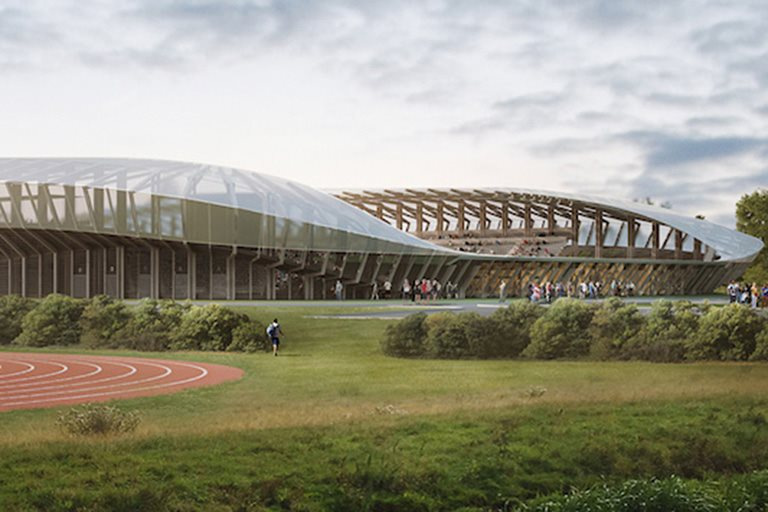
This is the future Forest Green Rovers Eco Park, in Gloucestershire:
As you may see, the current facilities of the football club (called the New Lawn) are pretty ill-suited. Access to the stadium is difficult, surroundings are totally cramped with traffic (like anywhere else in the UK…), visitors/fans cars cannot park easily on match days etc. The current stadium is built in non eco-friendly materials, so, all in all the cost to the environment is very dear!
The solution is to totally rebuild the facilities, in a more appropriate location, taking into account the eco costs. The project of the new eco park is on the way and could be delivered by 2028. However it faces difficulties, hence has not started yet due to local road planning around Stroud.
The initial project plan (that has been revised since 2019) features:
*carbon emitted when producing materials
Sports have massive global influence and can promote environmental action:
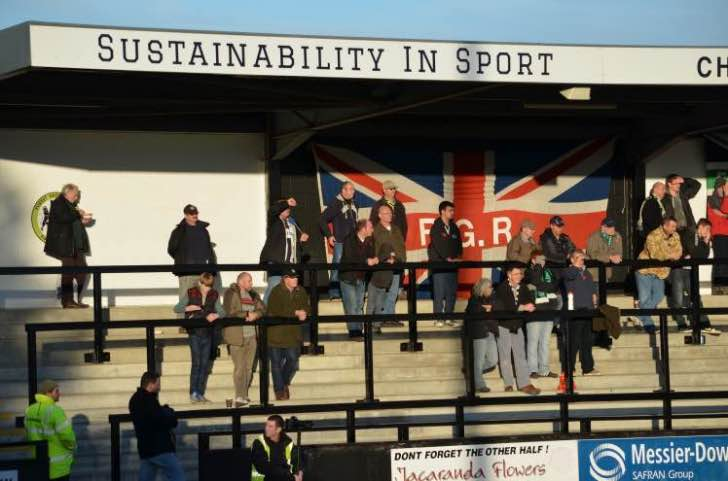
If we resume the example of Forest Green Rovers FC, we may see brand new green communication has kicked in, which in itself is fairly innovative:
|
|
 |
Things are moving, so are sports organisations and the public at large.
In Wales, for instance, some surveys were made, highlighting key findings and proving that people are definitely aware of the environmental problems they may cause when going to a match for instance.
For more info, see the details of that research.
Non-surprisingly, key findings showed that the main concern is first the lack of funding, but also revealed that people, organisations etc rather feel put off, not knowing when, where or how to start.
“Not enough funding was the greatest barrier for sports clubs and community organisations in the survey, and the second greatest barrier for governing bodies.
For governing and umbrella bodies, lack of capacity was the top barrier, with the majority lacking specific sustainability roles. These findings were reinforced through the interviews and focus groups with governing bodies wanting to “get their own house in order” before they feel they can support their members.
The interviews and focus groups indicated that clubs/groups understand the issues, but the main challenge is knowing where and how to start and having the time and money to do it: there is an implementation challenge. The survey identified the need to shift from awareness to practical action and behaviour change.
In recreational sport/physical activity, buildings and facilities are often not owned by the club/activity delivery partner, and this lack of control and ability to make changes was highlighted; placing emphasis on the role of influence, collaboration and shared action in achieving environmental sustainability ambitions.”
There is a need for clear guidelines, policy and measures, from top to bottom; the good news is that action plans have emerged for some time and implementation has started already:
These are only 2 examples, but there are many more, whether at national or international levels.
Where there is a will, there is a way. So, it is not so much the potential difficulty in undertaking changes that must be feared, but the lack of funding. As usual, money remains the key issue; we may draw a comparison with the healthcare sector, where medical progress and care is contravened by public financing difficulties and funding issues. As long as the healthcare or environmental sectors budgets have to balance, investment cannot and will not be enough.
Governments and societies will have to accept that they must pay the price to face the challenges environmental issues put up to them, however high it is; they will be losing money anyway since some 5 to 15% of the GDP is predicted be lost annually from 2050 onwards, as we saw earlier.
It is up to the next generations to make it all happen; accepting to change budgeting rules, priorities, overhauling the economy is in itself a revolutionary process, quite innovative, and sports may help and play a part in it.
As for sports… No choice!
The future of sports depends on environmental protection. Sustainable planning and implementation, and public awareness can help ensure sports thrive without harming the planet.
Innovation in sports must be sustainable – it is a MUST DO; otherwise it won’t be adopted. And as time puts more and more pressure on innovators (see conclusion of lecture on Innovation), so will the environment in a very near future.